
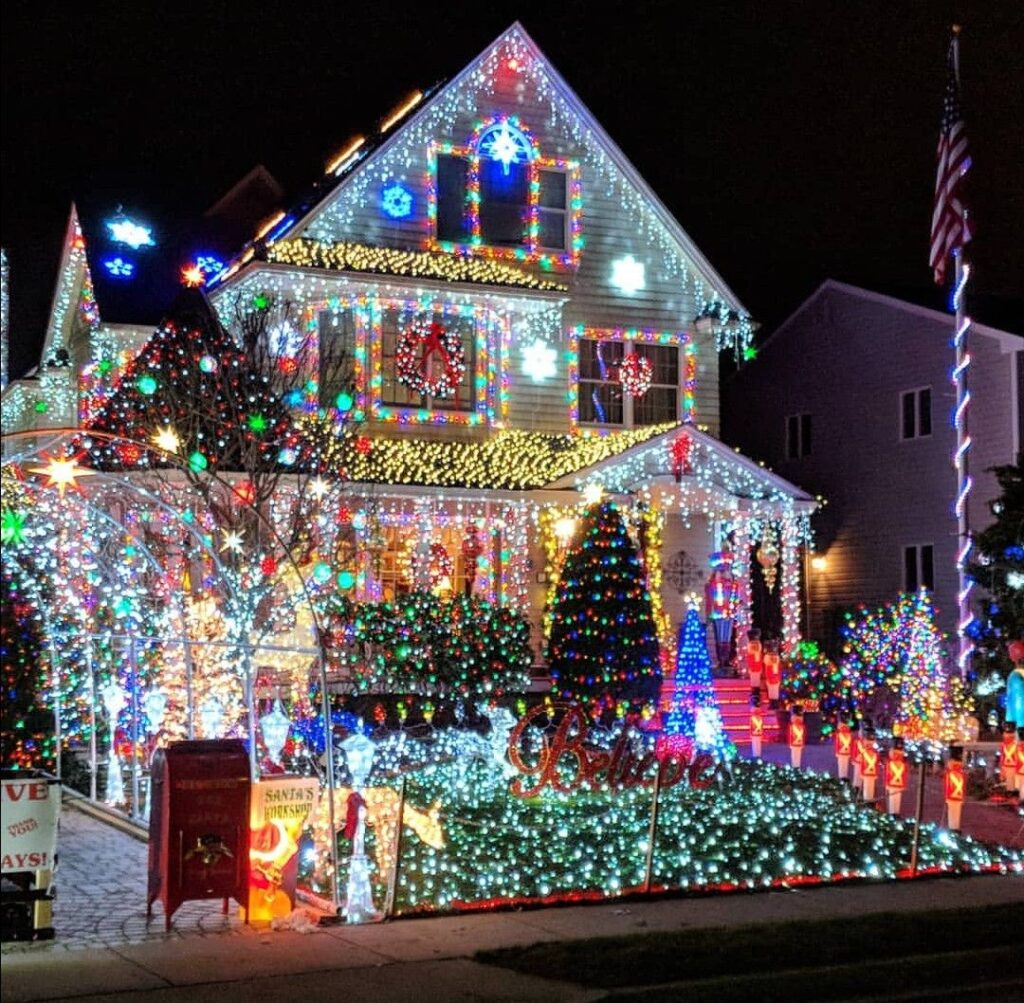

Blue, white, and red make a bold Christmas palette. It looks icy, classic, and a little patriotic all at once.
Planning house Christmas lights in blue, white, and red takes more than grabbing three boxes of bulbs. You need the right bulb size, safe power, and a clean layout. This guide walks through all three options.
What Is the Best Layout for House Christmas Lights Blue White Red?
The best layout for house Christmas lights blue, white, and red uses white as the anchor color. Run white along the roofline. Add red and blue in short repeating blocks on porch rails, windows, and trees. This keeps the display balanced and stops the three colors from fighting each other.
White should lead because it’s the easiest color to place. It also makes red and blue stand out. Blue with white looks cool and wintry. Red with white looks like candy canes. All three together look traditional and bright.
Match your whites to your colors. Cool white sits well next to blue. Warm white sits well next to red. Mixing both whites in one view looks messy, so pick one.
Try a repeating pattern. Two white, one red, one blue works well. Repeat it on every roof edge. Keep the order the same everywhere.

C7 C9 or Mini Which Bulb Size Fits Your House?
C9 bulbs fit rooflines best. They’re the largest common size and stay bright from the street. C7 bulbs suit smaller features like porch rails and windows. Mini lights suit trees, shrubs, and railings, where close viewing matters. Pick one size per feature so the display looks even.
Sizes step up in order. C6 is small, C7 is medium, and C9 is large. Bigger bulbs look brighter from farther away.
For house Christmas lights in blue, white, and red, a layered look works well. Put C9 bulbs on the roofline. Use C7 or mini lights on lower features. The mix adds depth without adding clutter.
LED or Incandescent for a Three Color Display
Most homes should choose LED. It stays cooler and requires less power. That matters when you plan a big display of house Christmas lights in blue, white, and red.
An incandescent mini string of 100 lights draws about 40 watts. Ten strings total 400 watts, or around 3.3 amps.A 100-bulb C9 LED string draws about 90 watts, or 0.75 amps. That gap lets you run a much longer display on one outlet.
Some people still prefer incandescent for its warm glow. That’s a fair choice. Just don’t mix the two types. LED and incandescent strings shouldn’t share one run, because their plugs and loads differ.
How Many Strands Can You Connect?
Follow the maker’s limit on the box. Incandescent C7 strings usually allow only 3 to 5 connected sets. LED C7 sets can often link 15 to 25. Going past the limit causes dimming and heat. Never mix LED and incandescent strings in one run.
Overloaded runs dim toward the far end. One homeowner fixed this by adding a second power source halfway along a 60-foot roofline. Use the same trick on long runs.
Plan your house Christmas lights blue, white red in runs with one or two colors each. That makes strand limits easy to track. It also keeps a single fault from darkening the whole house.
Add up your load before you plug in. Most good outdoor timers carry a 15 amp rating, and everything plugged into one counts against it. Two timers on two outlets often work better than one.
Weather Ratings Cords and GFCI Rules
Weather is the top threat to house Christmas lights blue, white, red. Rain, snow, and wind all test every connection.
Look for LED strands rated at least IP44 for outdoor use. IP65 lasts longer. Check the box before you buy.
Use a GFCI outlet for every outdoor plug. A portable GFCI adapter works if your outlet isn’t protected. Test the GFCI button monthly.
Pick the right extension cord too. Look for outdoor labels such as SJTW or SJTOW. Use 16-gauge cord for runs under 50 feet and 14-gauge for longer runs. Never use indoor cords outside.
Water in a connection causes most tripped GFCIs. Keep plugs and connections off the ground, with a drip loop that directs water away. Seal each junction with gaskets. Cap empty C7 and C9 sockets, since open sockets collect water.
Selection Checklist for House Christmas Lights Blue White Red
Use this list before you buy.
- Bulb size: C9 for rooflines, C7 or mini for smaller features
- Type: LED for lower power draw
- Rating: IP44 at minimum, IP65 for harsh weather
- Colors: One matching white for every color
- Connection limit: Read it on the box
- Clips: Match them to your gutters or roof material
Buy every strand for house Christmas lights blue, white, red in one batch when you can. Bulb tones vary between batches. A single mismatched white stands out fast.
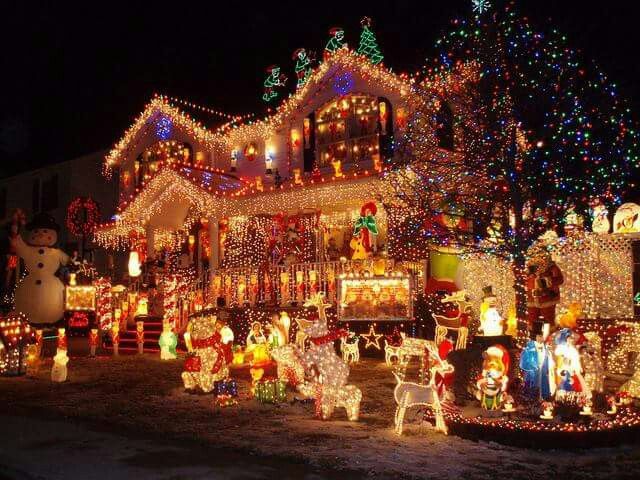
How to Measure Your Roofline
Measure before you buy house Christmas lights blue, white, red. Walk the roof edges with a tape or string. Add the corners and any peaks. Allow about 10% extra for waste.
Use about 12 inches of spacing between each clip.Bulb spacing of 6 to 12 inches gives even light. Your measured length beats any rule of thumb. Homes vary too much.
How to Install House Christmas Lights Blue White Red Step by Step
Set aside an afternoon for house Christmas lights blue, white, and red on a single-story home. Larger homes need more time and a helper.
- Test every strand on the ground. Swap dead bulbs before you climb.
- Sketch your color plan. Mark where each color block starts and ends.
- Set up the ladder safely. Keep a helper nearby and hold three points of contact when you climb.
- Pick clips for your surface. Plastic clips suit standard gutters and magnetic clips suit metal roofing. Skip nails and screws.
- Clip the white line first. Follow your 12-inch clip spacing.
- Add red and blue blocks in your set pattern. Keep the order the same on every edge.
- Make sure every connection stays off the ground. Add drip loops and gaskets.
- Plug the lights into a timer and GFCI outlet. A photocell timer can switch lights on at dusk and off at a set hour, such as 11 pm.
- Step back at night. Check for wavy lines and dark spots.
Fixing Common Problems
Even careful installations of house Christmas lights blue, white, red need small fixes.
- Bulb won’t light: Check the bulb seating and the contact pin at the bottom of the socket.
- Wavy line: Add clips at the midpoint between existing clips, then check the line at night.
- Dim far end: Add a second power source halfway.
- GFCI trips in rain: Find the wet connection. Lift it and seal it.
Storage and Care
Test every strand before you pack it. Wind each one loosely around a spool. Label the spool by color and length. Next year’s setup will go much faster.
The Bottom Line
House Christmas lights in blue, white, and red look best when white leads and the colors repeat in a clear pattern. Choose C9 bulbs for the roofline and LED for lower power draw. Follow the strand limits on the box. Use GFCI outlets and outdoor-rated cords.
Measure first, buy in one batch, and hang with a helper. Then enjoy the glow.
Read Also: Low Voltage Light Strings
FAQs
How many feet of lights does a house need?
Measure your roofline and add about 10 percent. Estimates vary a lot by home size. Your own measurement is the safest guide.
Can I mix LED and incandescent strings?
No. Keep each run to one type. Their plugs and loads differ.
Do outdoor Christmas lights need a GFCI outlet?
Yes. Use a portable GFCI adapter if your outlet lacks one. Test it monthly.
What bulb size works best on a roofline?
C9 works best. It’s large and stays bright from the street.
Should I use a timer?
Yes. A photocell timer starts lights at dusk. Check its amp rating first.
Why do my lights trip the GFCI in rain?
Water usually sits in a connection. Lift plugs off the ground and seal them.
What extension cord should I use?
Use an outdoor-rated cord. Choose 16 gauge under 50 feet and 14 gauge for longer runs.

Pingback: Lighting Christmas Lights With a Battery Displays - LED CCT