
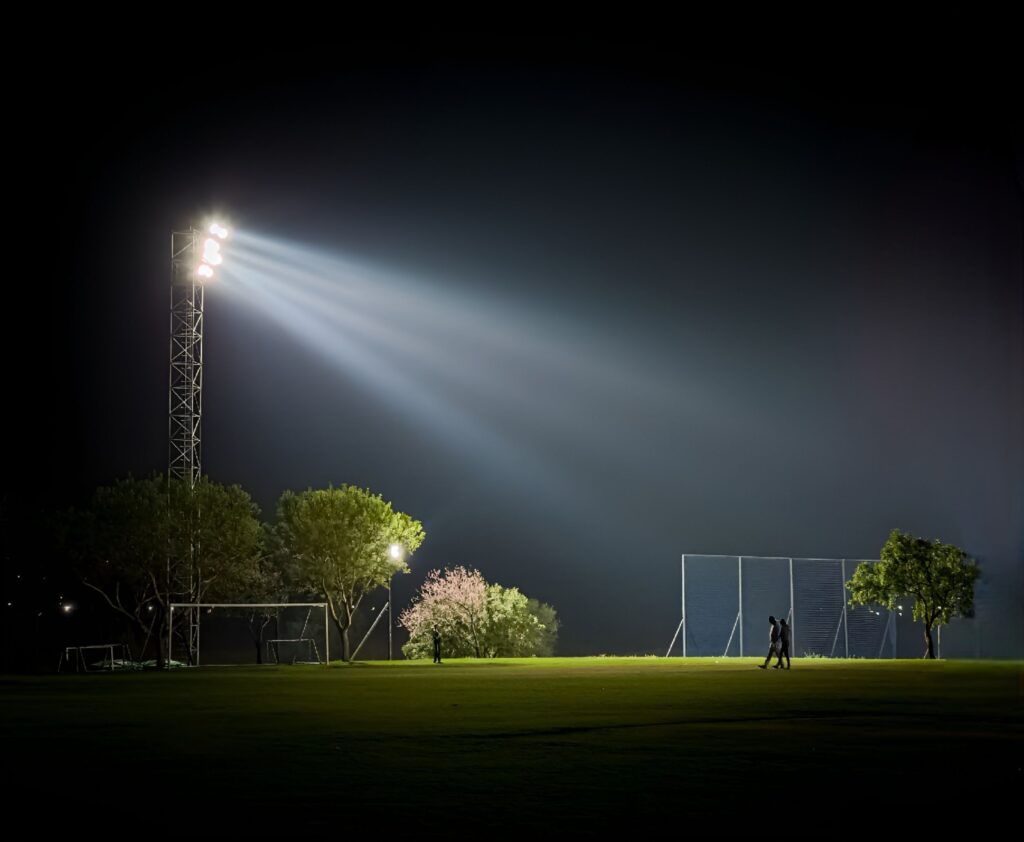

Good lighting keeps a driving range open after sunset.
Players expect clear visibility from the tee box to the landing area. Poor lighting can make it difficult to track golf balls, reduce safety, and affect the overall experience. That’s why many golf course owners and facility managers invest in golf driving range lighting that delivers consistent illumination across the entire range.
Modern lighting systems also reduce energy costs and maintenance compared to older technologies.
Selecting the right lighting solution starts with understanding brightness, fixture placement, beam angles, and local lighting requirements.

Golf Driving Range Lighting Overview
Golf driving range lighting provides consistent illumination for practice areas during the evening and in low-light conditions. Modern LED fixtures improve visibility, reduce energy consumption, and support player safety. Proper lighting design also creates even coverage across the tee line, ball landing zone, and target areas.
A well-designed system benefits players and facility operators.
It also supports year-round evening practice.
Why Golf Driving Range Lighting Matters
Lighting affects every practice session.
Players need to follow the ball from impact to landing. When lighting levels vary across the range, golfers may lose sight of the ball before it reaches its target.
Golf driving range lighting creates a brighter practice environment while helping players judge ball flight and distance more accurately.
Facility owners also benefit from longer operating hours.
Evening practice often generates additional revenue.
Benefits of LED Golf Driving Range Lighting
LED technology has become the preferred choice for golf facilities.
Compared with older metal halide fixtures, LEDs offer several advantages.
Golf driving range lighting systems using LED fixtures commonly provide:
- Lower energy consumption
- Longer operating life
- Faster full brightness
- Reduced maintenance
- Consistent light output
- Better color rendering
These advantages help reduce long-term operating costs.
Many facilities recover upgrade costs through lower utility and maintenance expenses.
Recommended Brightness Levels
Lighting requirements depend on the size and purpose of the range.
Public driving ranges often require balanced lighting that allows players to follow the golf ball without creating excessive glare.
Golf driving range lighting typically focuses on three primary areas:
- Tee boxes
- Ball flight path
- Landing area
Uniform lighting is often more important than maximum brightness.
Even coverage reduces dark spots throughout the range.
Choosing the Right LED Fixtures
Not every outdoor fixture performs well on a driving range.
Large open spaces require high-output luminaires with carefully selected beam angles.
When selecting golf driving range lighting, consider:
- Fixture wattage
- Beam angle
- Mounting height
- Weather resistance
- Light distribution
- Color temperature
Most facilities install LED floodlights designed specifically for sports lighting.
These fixtures provide wide and controlled coverage.
Pole Height and Fixture Placement
Pole placement affects lighting quality.
Poor placement can create shadows and uneven illumination.
Golf driving range lighting commonly uses poles ranging from 50 to 100 feet, depending on the facility layout and local regulations.
Higher mounting positions allow fixtures to distribute light across larger areas.
Proper spacing also helps reduce glare.
Best Color Temperature
Color temperature affects visibility.
Many sports lighting installations use neutral or cool white light.
A color temperature between 4000K and 5700K often provides clear visibility while maintaining natural color appearance.
This range allows golfers to follow the ball more easily during evening practice.
Uniform Lighting Is More Important Than Maximum Brightness
Some facilities focus only on increasing brightness.
That approach can create glare and uneven lighting.
Golf driving range lighting should provide balanced illumination across the practice area.
Consistent light distribution helps players track ball flight from start to finish.
Energy Savings with LED Systems
Energy efficiency has become a major consideration.
Older lighting systems often consume large amounts of electricity.
Golf driving range lighting powered by LEDs can reduce energy use while maintaining reliable performance.
Many systems also support smart lighting controls.
Operators can adjust lighting levels based on operating hours and customer demand.
Weather Resistance and Durability
Outdoor lighting operates in changing weather conditions.
Rain, wind, heat, and cold can affect equipment over time.
Golf driving range lighting fixtures should include durable housings and weather-resistant ratings suitable for long-term outdoor use.
Corrosion-resistant materials can also extend equipment life.
Maintenance Requirements
Routine inspections help maintain lighting performance.
Facility managers should regularly inspect:
- Fixture alignment
- Electrical connections
- Pole condition
- Lens cleanliness
- Control systems
LED fixtures generally require less maintenance than traditional sports lighting.
Their longer operating life reduces replacement frequency.
Common Mistakes When Installing Golf Driving Range Lighting
Several installation mistakes can reduce lighting quality.
Common examples include:
- Uneven pole spacing
- Incorrect beam angles
- Insufficient fixture height
- Excessive glare
- Poor aiming
- Choosing fixtures with inadequate output
Professional lighting design helps avoid these issues.
Proper planning improves both visibility and player comfort.
Planning a Golf Driving Range Lighting Project
Every facility has different requirements.
Project planning should consider:
- Range dimensions
- Pole locations
- Local lighting regulations
- Energy goals
- Budget
- Future maintenance
A detailed lighting plan supports efficient installation and consistent results.
Visit Also: Golf Lights
FAQs
What is golf driving range lighting
Golf driving range lighting is an outdoor lighting system designed to illuminate practice ranges, allowing golfers to practice safely after sunset.
Why are LED fixtures used for golf driving ranges
LED fixtures provide lower energy consumption, longer operating life, consistent brightness, and reduced maintenance compared with older lighting technologies.
What color temperature works best for a driving range
Many facilities use lighting between 4000K and 5700K because it provides clear visibility and natural color appearance.
How tall are golf driving range lighting poles
Pole height varies by project, but many installations use poles between 50 and 100 feet to achieve broad and even coverage.
Does golf driving range lighting reduce operating costs
Yes. LED lighting systems often lower electricity use and maintenance expenses while extending fixture lifespan.
Can existing driving ranges upgrade to LED lighting
Yes. Many golf facilities replace older metal halide systems with LED fixtures to improve efficiency, visibility, and long-term operating costs.
Conclusion
Golf driving range lighting plays a critical role in creating a safe, comfortable, and productive practice environment. Proper fixture selection, balanced light distribution, appropriate pole placement, and efficient LED technology all contribute to better visibility across the entire range.
Whether building a new facility or upgrading an existing one, investing in a well-designed lighting system can improve player satisfaction, extend operating hours, and reduce long-term maintenance and energy costs. Careful planning helps ensure reliable performance for years to come.


